
PerspectivesNovember 11, 20252 min read
Why Existing Airports Are Not the Whole Answer for AAM
Existing airports and heliports will play an important role in early eVTOL operations. But scalable urban air mobility requires infrastructure closer to demand, designed around different operational and commercial realities.
Why Existing Airports Are Not the Whole Answer for AAM
A common question around vertiports is: Why build new infrastructure when airports already exist? Existing airports and heliports will almost certainly play an important role in early eVTOL operations. They already have aviation infrastructure, established procedures and experienced operators. But they were designed for a different purpose. Major airports are built around hub operations, larger aircraft, security processing and high passenger volumes. They are not necessarily optimized for frequent, short-distance journeys using aircraft carrying only a handful of passengers. For an urban trip, travelling significant distance to a congested airport simply to begin a short flight can also remove much of the time advantage aviation is intended to create.
Starting infrastructure is not always scaling infrastructure
The distinction matters. An airport may be an excellent place to begin operations without being the best place from which to build an entire urban network. Small aircraft operating alongside high-volume commercial aviation face different economics, including airport charges, slot availability, passenger processing and turnaround requirements. This is part of what limited earlier visions of widespread urban helicopter transport. Helicopters established durable roles where their operational value was clear, including emergency services, offshore operations, firefighting and defence. But broad passenger mobility never developed into the connected urban network once imagined. Infrastructure was one part of that challenge.
Today’s environment is different
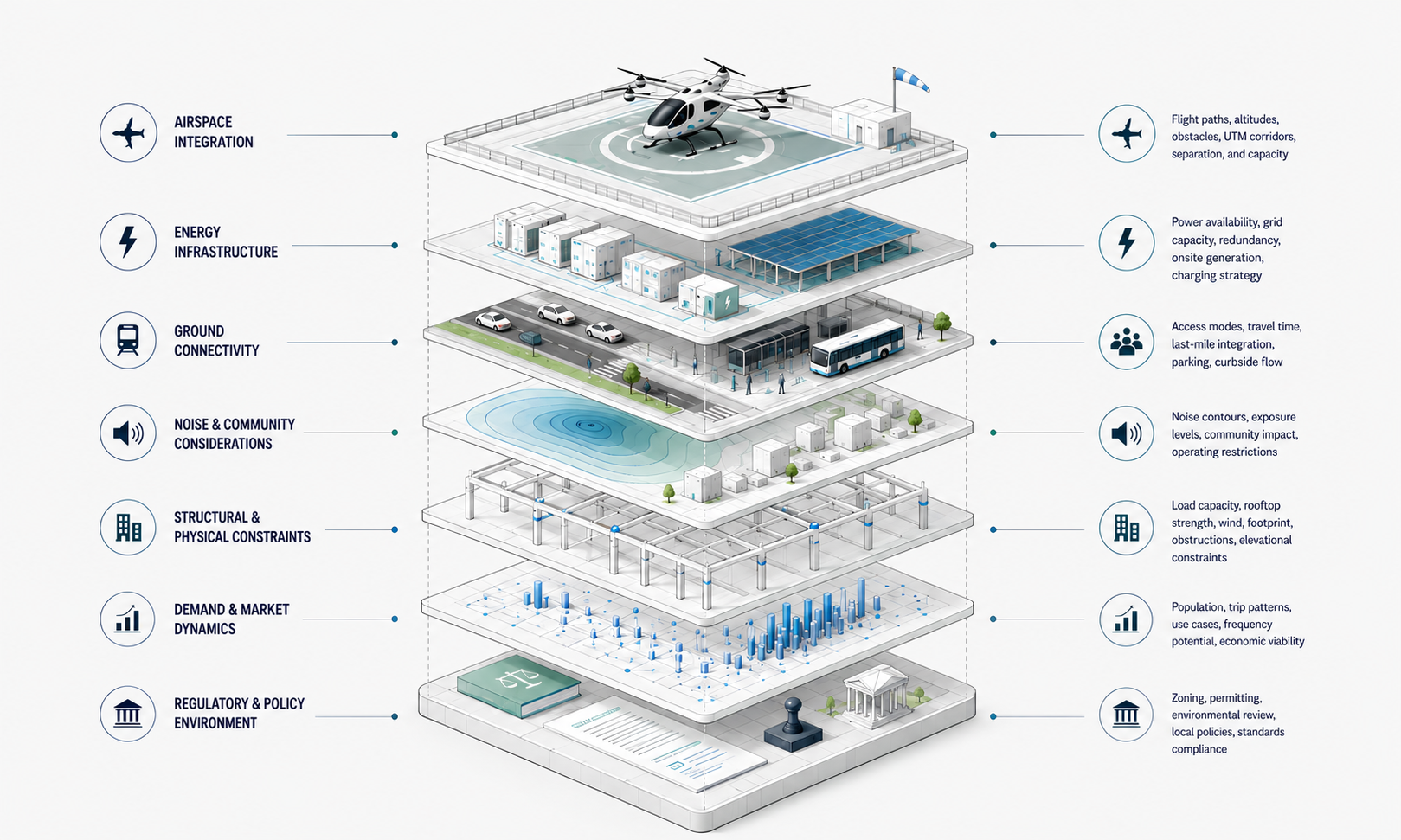
Conditions have changed. Cities are denser. Digital mobility platforms have changed how journeys are booked. Logistics demand has increased. Distributed energy infrastructure is developing, and new aircraft may have different operating economics and noise characteristics. None of this guarantees that Advanced Air Mobility will scale. But it creates a different environment in which to evaluate the opportunity. The answer is therefore neither “use existing airports” nor “build vertiports everywhere.” It is to determine where aviation can create enough value to justify the infrastructure. That requires airspace, demand, energy, ground connectivity, noise, regulation, physical constraints and operational capacity to be evaluated together. At LYNEports, this is why we treat site selection as more than a location-scoring exercise. A high-scoring site on a map is not necessarily a viable aviation asset. The real question is whether that location can support safe, scalable and economically meaningful operations over time. Existing airports may help the industry begin. The infrastructure required to scale it may look very different.